
Thailand to Argentina Transoceanic LNG Tank Container Long-Distance Multimodal Transport Project
With the energy transition in South America and the arrival of the seasonal peak in winter heating demand, Argentina's demand for liquefied natural gas (LNG) has increased significantly. A major Argentine energy importer has reached a procurement agreement with our Thai clean energy supplier. Due to the lack of large LNG receiving terminals and direct pipelines to some inland destinations in Argentina, traditional large LNG carriers (LNGCs) cannot directly reach them. Therefore, how to safely, flexibly, and economically transport natural gas resources from Bangkok, Thailand, across the ocean to inland Argentina has become the core technical bottleneck for the cooperation between the two companies.
It is necessary to overcome the limitations of traditional unloading at ports, which prevent further inland transport, and achieve direct delivery to the terminal.
The route from Thailand to Argentina is long (over 15,000 kilometers), and it is essential to ensure that the pressure and temperature of the LNG tanks remain absolutely stable under long-term sea conditions and drastic temperature changes.
Long international shipping cycles necessitate efficient global reverse logistics scheduling for empty tanks after unloading in Argentina to reduce equipment idle costs.
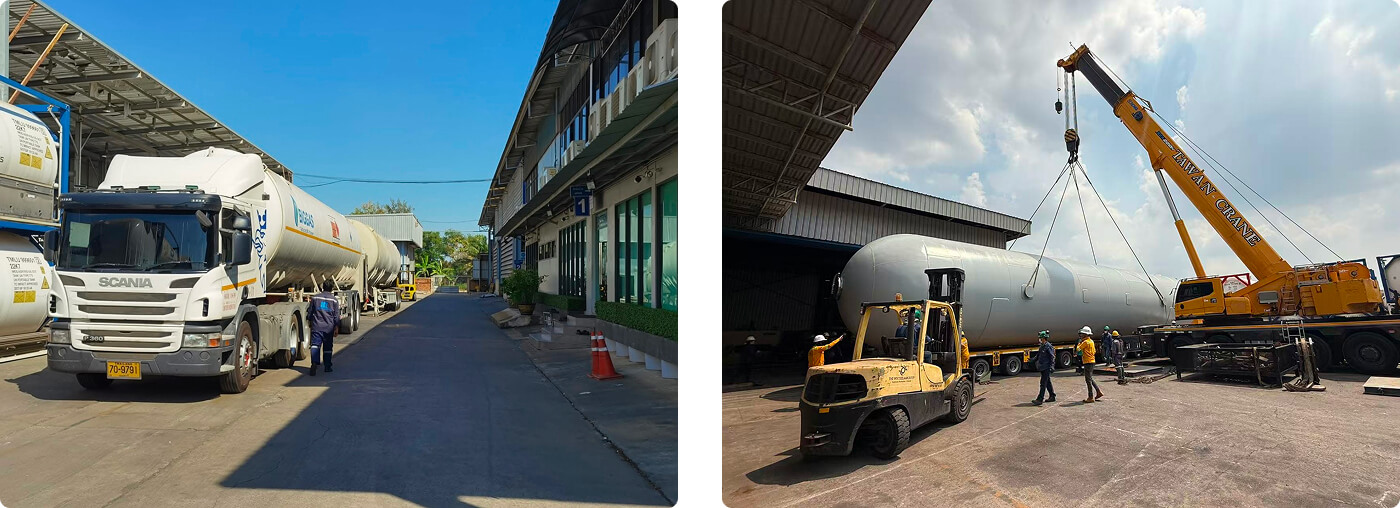
We customized a comprehensive transoceanic intermodal transport solution for our client, encompassing "Thailand land transport filling - international sea freight liner - Argentine heavy-duty truck transshipment." By introducing internationally standardized ISO tank containers, goods are filled in Thailand and directly transported via container liner across the ocean. Upon arrival in Argentina, they are directly delivered to inland consumer terminals by local hazardous materials trucks, achieving "no tank transfer, no transshipment." Simultaneously, global positioning and temperature/pressure sensing IoT terminals are deployed throughout the process, enabling 24-hour transoceanic data tracking via satellite network.
LNG is filled into standard ISO tank containers at the Bangkok LNG terminal in Thailand and undergoes extremely rigorous transoceanic sealing and pressure resistance tests.

Tank containers enter the container terminal and embark on a long-distance voyage across the Pacific and Atlantic Oceans via international liner services. They are strictly prohibited from being placed on deck exposed to direct sunlight throughout the journey.
The dispatch center utilizes low-Earth orbit satellite IoT technology to monitor the internal pressure, temperature, and GPS location of the tanks in real time during the ocean voyage.
After the liner arrives at the Port of Buenos Aires, Argentina, it undergoes rapid customs clearance through the hazardous materials green channel. Specialized hazardous materials heavy trucks then transfer the cargo, delivering it directly to inland Argentine businesses for the "last mile."
Logistical Flexibility: Successfully established a supply chain spanning half the globe, enabling small and medium-sized enterprises in inland Argentina to directly use clean energy from Thailand for the first time.
Safety Record: During the more than 30-day transoceanic voyage, temperature fluctuations were kept within safe limits, achieving zero leaks, zero cargo damage, and zero safety incidents.
Customer Testimonial: "Faced with a long route exceeding 15,000 kilometers, the solution's end-to-end container handling and satellite monitoring capabilities are truly impressive. They not only solved our inland transportation challenges but also established an incredibly secure international green energy corridor."


